

An ancient Sanskrit word holds the key to understanding one of South Asia’s most dramatic historical turning points. That word is “Turaska.” It survived in old texts, royal records, and scholarly debates for more than a thousand years. And in 2026, it still tells us something important about identity, foreign contact, and the making of a civilization.
“Turaska” is an old Sanskrit term used in Indian texts to describe foreign peoples, particularly groups from Central Asia and the Turkic world. It appears in texts like the Mahabharata, the Puranas, and medieval Sanskrit chronicles. Over centuries, the word shifted from a broad label for outsiders to a more specific marker for Turkic-origin rulers and warriors who reshaped Indian politics and culture between the 10th and 13th centuries.
Quick Info: Turaska at a Glance
| Feature | Detail |
| Word origin | Sanskrit |
| Primary meaning | Foreigners, specifically Central Asian or Turkic peoples |
| Earliest textual appearances | Mahabharata, Puranas (compiled over 300 BCE to 1000 CE) |
| Key related term | Turuska (alternate Sanskrit spelling) |
| Linked historical figure | Mahmud of Ghazni (971-1030 CE) |
| Related texts | Rajatarangini (composed c. 1148-1150 CE by Kalhana) |
| Languages influenced | Sanskrit, Apabhramsha, Urdu, Hindi |
| Modern scholarly relevance | South Asian history, identity studies, linguistic history |
| Region of primary use | Indian subcontinent, especially northern India |
| Connected cultural legacy | Indo-Islamic architecture, Persian literary tradition, Urdu language |
What Is Turaska? A Clear Definition
Turaska (also spelled Turuska in several manuscripts) is a Sanskrit word that ancient and medieval Indian writers used to describe people they saw as foreign, particularly those arriving from Central Asia and the Turkic regions to the northwest. Think of it as the Sanskrit equivalent of a category label. It helped writers place certain groups outside the familiar social and cultural world of Indian society.
The word is not merely descriptive. It carries layers of meaning about power, difference, and historical change. It appears in some of India’s oldest surviving literature and later in detailed medieval chronicles. By tracing Turaska through time, you can watch history unfold through language.
How Does the Meaning of Turaska Change Across Time?
Early uses of Turaska were broad. Writers applied it to various groups from the northern and northwestern frontiers. These could be nomadic peoples, traders, or distant tribal groups. The word simply marked someone as an outsider to the dominant Sanskrit-speaking cultural world.
By the medieval period, around the 10th to 13th centuries CE, the meaning narrowed. Turaska became closely linked with Turkic military groups and rulers entering the subcontinent. This shift happened because history itself shifted. Real Turkic armies, commanders, and dynasties were now physically present in India. The word went from a literary category to a live political label.
Where Did Turaska Come From? The Sanskrit Root Debate

Scholars have debated the exact linguistic origin of Turaska for decades. No single agreed explanation exists. However, several strong theories have emerged from historical linguistics and Sanskrit studies.
One theory connects Turaska with older Indian attempts to transliterate or adapt a foreign ethnic name into Sanskrit phonology. Sanskrit writers often adapted foreign words to fit their own sound system. A name like “Türk” or a related Central Asian term could have been rendered into Sanskrit as Turaska through this adaptation process.
A second line of thought links the root to words meaning movement or swiftness. This fits the image of mounted Central Asian warriors. Horse-riding, mobile warfare was the defining feature of most Turkic groups that entered Indian consciousness. That association likely shaped how the name felt to Indian ears.
A third possibility is that the word developed independently within Sanskrit as a composite marker for a geographic and ethnic category. Sanskrit writers used specific suffixes to build labels for foreign peoples and distant lands. The “-ka” suffix was one common way to do this.
None of these explanations is definitive. The honest answer is that Turaska’s origin sits at the crossroads of Sanskrit linguistics and Central Asian ethnic history, and that crossroads is still being studied.
Why Does the Word’s Origin Matter?
The origin question matters because it tells us whether Indian writers were naming something they directly observed or borrowing and adapting a name from outside. If they adapted the name, it suggests early contact with Turkic-speaking groups or awareness of a foreign self-identity. If they invented it, it tells us more about how Indian observers categorized outsiders.
Either way, Turaska is evidence that ancient Indian writers were paying close attention to the world beyond their borders.
Turaska in the Mahabharata and the Puranas
The oldest appearances of Turaska place it inside India’s massive classical literary tradition. The Mahabharata, one of the two great Sanskrit epics, contains references to various foreign peoples and distant lands. Turaska appears here as part of a wider catalog of peoples known or imagined to exist beyond the subcontinent’s familiar borders.
These early appearances are not historical records in the modern sense. The Mahabharata was compiled over many centuries, with layers of text added at different periods. Scholars date the core narrative to roughly 400 BCE to 400 CE, with later additions continuing after that. So when Turaska appears in this text, it tells us that by some point in this long window, Indian writers were aware of a group they called by this name.
The Puranas, a collection of religious and mythological texts, also reference groups like the Turaska. These texts were regularly updated and revised across centuries. They served as encyclopedic repositories of history, myth, geography, and social custom. Their references to foreign peoples show that Indian intellectual culture was always keeping track of the outside world, even in religious literature.
What Do These Early Texts Actually Say?
The Puranas often list foreign peoples together in catalogs of distant tribes or outsiders who lived beyond the four main social orders of classical Indian society. This placement is telling. It does not necessarily imply hostility. It implies difference. Writers were saying, “These are people we know exist, but they live by different rules.”
In some Puranic passages, Turaska-type groups appear alongside other named peoples from the northwest and central Asian frontiers. This geographic clustering matches the historical reality. The main routes into India from Central Asia ran through the northwest, through what is today Afghanistan and Pakistan. Writers were mapping the world as they understood it.
The Rajatarangini: A Key Medieval Source for Turaska
The most important medieval Sanskrit chronicle for understanding Turaska is the Rajatarangini, composed by the Kashmiri scholar Kalhana around 1148 to 1150 CE. This text, whose title translates as “River of Kings,” is a detailed account of the rulers of Kashmir. It is one of the earliest works in Sanskrit that comes close to what we would today call a genuine historical chronicle.
Kalhana uses the term “Turuska,” the alternate form of “Turaska,” to describe Turkic rulers and military groups active in his era. His usage is specific and politically charged. He is describing real events. Turkic power was not a distant rumor in his time. It was a present political reality affecting the region around him.
The Rajatarangini is notable because Kalhana tried to write with critical judgment. He was not simply praising kings or repeating myths. He weighed evidence, acknowledged uncertainty, and sometimes criticized rulers he was writing about. This makes his use of Turaska especially valuable. It reflects genuine contemporary observation, not just literary convention.
Kalhana’s Perspective on Turaska Groups
Kalhana’s tone toward Turuska groups was mixed. He recorded both conflict and coexistence. He noted Turkic military strength and political disruption. But he also recorded periods of relative stability and interaction. This ambivalence is important. It shows that the Turaska label did not automatically mean enemy. It meant something more complex.
Real-life comparison: think of how a modern journalist might write about a neighboring country. Sometimes critical, sometimes neutral, sometimes admiring of specific achievements. That mix of reactions is what you often find in Kalhana’s approach to Turaska groups.
Turaska and Mahmud of Ghazni: Where History Gets Very Real
The most concrete historical link to Turaska comes with the campaigns of Mahmud of Ghazni, who ruled from the Ghaznavid capital in modern Afghanistan from 998 to 1030 CE. He led at least 17 raids into northern India, targeting temples, cities, and ruling dynasties. These raids became one of the most documented and debated events in medieval Indian history.
Mahmud was of Turkic origin. In the framework of Sanskrit historical writing, he and his forces would fall squarely under the Turaska label. His campaigns reached as far as Gujarat in the west and Punjab in the north. The raid on the Somnath temple in 1025 CE is the most famous and most discussed of all his Indian campaigns.
Indian writers of the period and later centuries responded to Mahmud’s campaigns in various ways. Some recorded them with alarm and grief. Others framed them in religious terms. Some later writers used events like Somnath to build political arguments centuries after the fact. This shows how Turaska-linked events became part of a long-running conversation about identity, loss, and historical memory.
What Was the Real Scale of Ghaznavid Impact?
The impact was significant but not total. Mahmud raided but did not permanently occupy most of what is today India. His political base was further west, in Afghanistan and Central Asia. His raids extracted wealth and disrupted political order in certain zones. But large parts of the subcontinent continued under existing rulers during and after his campaigns.
This distinction matters. Turaska in Mahmud’s era meant a powerful external force. It did not mean full conquest or total political replacement in most regions. That larger transformation came later, with the Delhi Sultanate beginning in 1206 CE.
How Turaska Connects to the Delhi Sultanate
The establishment of the Delhi Sultanate in 1206 CE marks the point where Turkic-origin political power moved from raiding to permanent rule over large parts of northern India. This is where Turaska shifts from a label for invaders to a label for rulers.
The Delhi Sultanate was founded by Qutb-ud-din Aibak, a Turkic commander who had served under Muhammad of Ghor. From 1206 onward, the sultanate controlled a large and growing territory. It introduced new administrative systems, court culture, architecture, and patterns of rule that shaped India for generations.
This is where the Turaska story becomes one of transformation rather than just conflict. Groups once described as outside now ran the state. They built cities, administered tax systems, patronized scholars and poets, and over time developed distinctly Indian cultural forms. The outsider had become a builder.
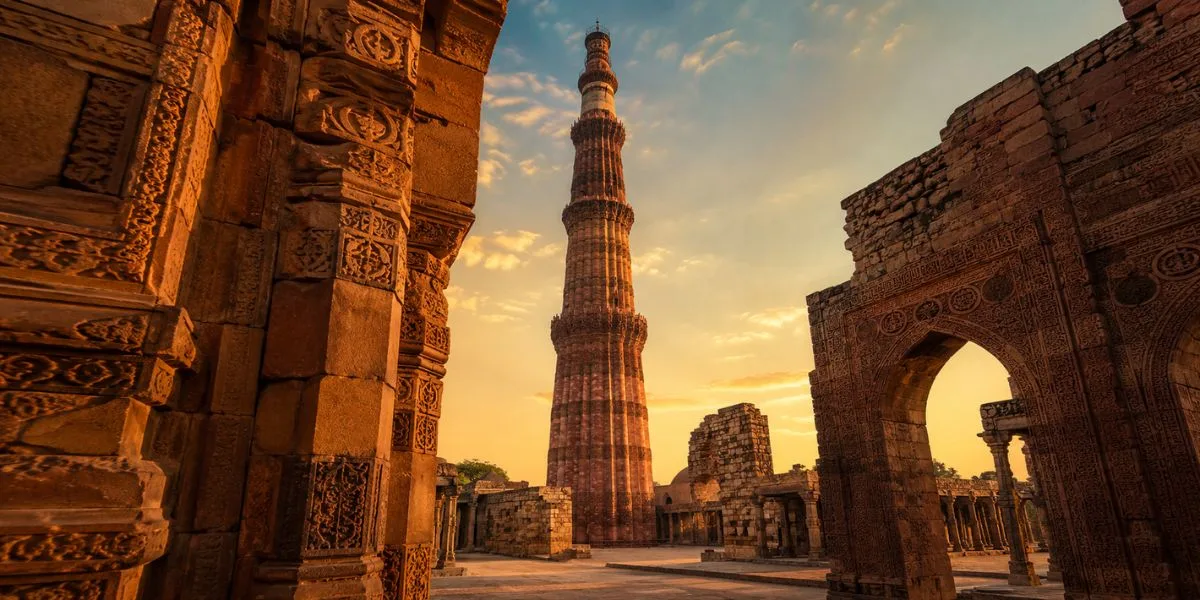
The Qutb Minar, completed in phases between approximately 1193 and 1386 CE, stands in Delhi today as one of the most visible products of this era. It is a UNESCO World Heritage Site and one of the finest examples of early Indo-Islamic architecture anywhere in the world. You can visit it today and see in stone exactly what the Turaska story eventually produced.
Turaska and Architecture: What You Can Still See Today

Architecture is the easiest place to see Turaska’s legacy with your own eyes. When Turkic rulers established themselves in India, they brought building traditions from Central Asia and Persia. These met Indian building skills, materials, and decorative traditions. The result was a new architectural style that belonged fully to neither place of origin.
Key features of this new style included the following:
- Pointed arches replacing the flat lintels of earlier Indian temple and palace construction
- Large domes over prayer halls and tombs
- Intricate geometric and calligraphic surface decoration
- Large open courtyards in mosque and madrasa design
- Combination of local red sandstone and imported aesthetic ideas
Buildings like the Qutb Minar complex, the Alai Darwaza (built in 1311 CE under Alauddin Khalji), and later the Tughlaq-era monuments all show how this blended tradition developed over time. Each generation of builders added local elements. Each generation adapted foreign influences.
This architectural transformation is direct physical evidence of what Turaska means in the long run. Contact, conflict, coexistence, and creation. All four happened. And the buildings are still standing.
Turaska and the Persian Language Revolution
One of the most lasting consequences of the Turaska story is linguistic. When Turkic rulers established their courts in India, they brought Persian as their primary language of culture, administration, and intellectual life. Persian was not Turkic. But it was the prestige language of the Islamic world from Central Asia to Iran to northern India. Turkic rulers had adopted it as their court language before they ever reached India.
This matter is significant. Persian became the language of government records, royal proclamations, diplomatic letters, historical writing, and high poetry across the Delhi Sultanate and its successor states. If you were an ambitious scholar, official, or poet in northern India between roughly 1200 and 1700 CE, you needed Persian.
Indian scholars and writers responded actively. Many learned Persian. Some wrote in it. Some created works that blended Sanskrit and Persian knowledge traditions. The Dabistan al-Mazahib, a 17th-century Persian text, is one example of how Persian became a vehicle for discussing Indian religious and philosophical traditions. This cross-fertilization was real and ongoing.
The long-term result was Urdu, a language that grew from the mixing of Persian, Arabic, and local Indian speech. According to the Linguistic Survey of India, Urdu today has hundreds of millions of speakers across South Asia. Its literary tradition is one of the richest in Asia. That tradition has roots going back directly to the Persian language revolution that the Turaska story helped set in motion.
Turaska and Sufism: The Cultural Bridge

No account of Turaska is complete without Sufism. Sufi teachers and saints arrived in India alongside and after Turkic rulers. They played a role in cultural contact that was different from political power. They focused on spiritual practice, personal devotion, music, and accessible teaching.
Major Sufi figures active in this period included Moinuddin Chishti (c. 1141-1236 CE), whose shrine in Ajmer, Rajasthan, remains one of the most visited spiritual sites in India today. The Chishti order he helped establish became famous for its use of music (qawwali), its openness to all people regardless of background, and its deeply Indian character.
Sufi dargahs, the shrines built around the tombs of saints, became meeting places for people of different faiths, communities, and social classes. This was not just religious tolerance as an abstract idea. It was daily life. People came to pray, to ask for blessings, to hear music, and to feel community. These spaces helped bridge the gap between what was once Turaska and what was now neighbor.
Real-life example: the qawwali musical tradition, made globally famous by the late Nusrat Fateh Ali Khan, traces its roots directly to the Sufi cultural spaces created in the post-Turaska era of Indo-Islamic contact. When you hear that music, you are hearing one product of the world Turaska helped create.
What Did Turaska Mean for Ordinary People?
A question the big histories often skip: what did all this mean for ordinary people? Not kings, not scholars. People are farming, trading, building, and raising families.
The honest answer is mixed. Raids like Mahmud’s caused real suffering. Temple destruction, forced movement, and economic disruption were real for communities in the affected zones. This should not be minimized or sentimentalized.
At the same time, much daily life continued with remarkable persistence. Local rulers stayed in place across large areas. Agricultural patterns, village customs, festival cycles, and family traditions showed enormous continuity. Outside political change touched cities and court centers more than it touched rural life in the short term.
Over generations, change seeped deeper. New goods arrived through expanded trade. New words entered daily speech. New building styles changed what towns looked like. New musical forms spread through communities. In a hundred years, what had once felt foreign often felt normal.
This is one of the most human parts of the Turaska story. Big historical forces work through ordinary life slowly. Not in dramatic announcements but in small shifts, borrowed words, and changing habits. That is how Turaska and its era shaped the ordinary world.
Turaska in 2026: Why Scholars and Curious Readers Still Care
In 2026, the word “Turaska” still generates academic discussion and public interest for several reasons.
First, it sits at the intersection of South Asian history, Central Asian history, and the history of Sanskrit as a literary and intellectual language. All three fields are growing. More scholars are working across these areas than ever before, partly because digitization has made old manuscripts accessible to researchers around the world.
Second, debates about identity, belonging, and historical memory remain politically alive in South Asia. Questions about who shaped Indian civilization, how foreign influence should be understood, and what the medieval period means for modern national identity are not purely academic. They touch real political debates today. Turaska is one historical concept that helps people engage with these questions using actual evidence rather than myth.
Third, the word helps connect different fields: linguistics, archaeology, art history, numismatic studies (coin evidence is important for tracing Turkic rulers), and religious history. Each field adds a layer to the picture. The complete Turaska story requires all of them.
Key Takeaways
- Turaska is a Sanskrit term for foreign peoples, primarily Central Asian and Turkic groups, used in Indian texts from ancient times through the medieval period.
- The word appears in major texts, including the Mahabharata, the Puranas, and the medieval chronicle Rajatarangini, composed around 1148-1150 CE.
- Turaska became closely tied to Turkic military and political power in India, especially during and after the campaigns of Mahmud of Ghazni (998-1030 CE) and the establishment of the Delhi Sultanate in 1206 CE.
- The Turaska era produced lasting cultural transformations in architecture, language, music, and spiritual life, including the growth of Urdu and Indo-Islamic architectural traditions.
- The word’s meaning shifted over time from a broad outsider label to a specific political marker, showing how language adapts to historical change.
- Studying Turaska in 2026 still matters because it helps us understand cultural contact, identity formation, and the making of South Asian civilization in an evidence-based way.
The Turaska Story Ends Where History Never Does
Turaska started as a Sanskrit word for people who felt distant and different. It ended up naming forces that built some of India’s most beautiful monuments, created one of its richest literary languages, and contributed to its most beloved musical traditions. That journey from outsider label to civilizational ingredient is one of history’s most striking stories.
The word reminds you that names carry history. Every label a society creates for “the other” tells you something about that society’s fears, curiosities, and eventual openness to change. Turaska tells you about a world in motion, a subcontinent meeting its neighbors, and a culture absorbing, adapting, and creating something new.
You do not need to be a historian to find value in Turaska. You just need to be curious about how people, words, and ideas travel across time. That curiosity is exactly what the Turaska story rewards. Keep following it, because the deeper you look, the more you find.
Frequently Asked Questions About Turaska
What does Turaska mean in Sanskrit?
“Turaska” is a Sanskrit word that ancient and medieval Indian writers used to describe foreign peoples, especially groups from Central Asia and the Turkic world. Early uses were broad, covering various outsiders from the northwestern frontier. Over time, the meaning became more specifically tied to Turkic-origin military groups and rulers active in India from the 10th century onward.
Where does the word “Turaska” appear in old texts?
Turaska and its variant Turuska appear in several major Sanskrit works. These include the Mahabharata, various Puranas, and the medieval Kashmiri chronicle Rajatarangini by Kalhana, completed around 1148-1150 CE. The Rajatarangini is one of the most historically specific sources, using the term to describe real Turkic political forces active in Kalhana’s era.
Is “Turaska” related to the word “Turk”?
Many scholars believe there is a connection between “Turaska” and the ethnic/political term “Turk,” with Sanskrit writers adapting a foreign name into their own phonological system. However, this is not universally settled. Sanskrit used specific suffix patterns to build category labels for foreign peoples, so the name may also have been partly constructed from within Sanskrit rather than purely borrowed.
What is the connection between Turaska and Mahmud of Ghazni?
Mahmud of Ghazni (971-1030 CE) was a Turkic-origin ruler who led at least 17 campaigns into northern India. In the framework of Sanskrit historical writing, he and his forces represented what the term “Turaska” increasingly described in the medieval period. His raids, particularly the 1025 CE attack on the Somnath temple, became defining events in how Indian writers discussed Turaska-type forces in their chronicles and later historical memory.
How did Turaska groups change Indian culture?
The Turaska era contributed to major changes in Indian architecture, language, music, and spiritual life. New building styles blending Central Asian and Indian traditions produced landmarks like the Qutb Minar. Persian became a major literary and administrative language, eventually contributing to the growth of Urdu. Sufi traditions introduced new forms of devotional music, including the qawwali tradition. These changes were deep and lasting.
Why is Turaska still relevant in 2026?
Turaska remains relevant because it sits at the center of ongoing debates about South Asian history, identity, and cultural formation. As digital access to old manuscripts grows, more scholars are studying how terms like Turaska were used and what they reveal about how societies understood themselves and their neighbors. The word also helps connect different historical fields, including linguistics, architecture, religious history, and political history, into a single story.
What is the difference between Turaska and Turuska?
Turaska and Turuska are variant spellings of the same Sanskrit term. The difference comes from regional manuscript traditions, copyist habits, and the natural variation that occurs when a word is copied by hand across centuries and geographic regions. Both forms refer to the same concept and are used interchangeably in scholarly discussion. The Rajatarangini by Kalhana tends to use the Turuska form.
Did Turaska always have a negative meaning?
No. The word’s tone varied by context, author, and era. Some texts used it with a sense of distance or otherness, but this was descriptive rather than always hostile. Kalhana’s Rajatarangini, for example, recorded both conflict and coexistence with Turaska groups. Over time, as Turkic-origin rulers became established builders and patrons of culture in India, the associations of the word naturally became more complex.
READ MORE: Cesta Roman: The Complete Guide to Rome’s Road Network That Built an Empire 2026
[…] READ MORE: 7 Shocking Facts About “Turaska”: The Ancient Sanskrit Word That Reveals India’s Hidden Histo… […]