

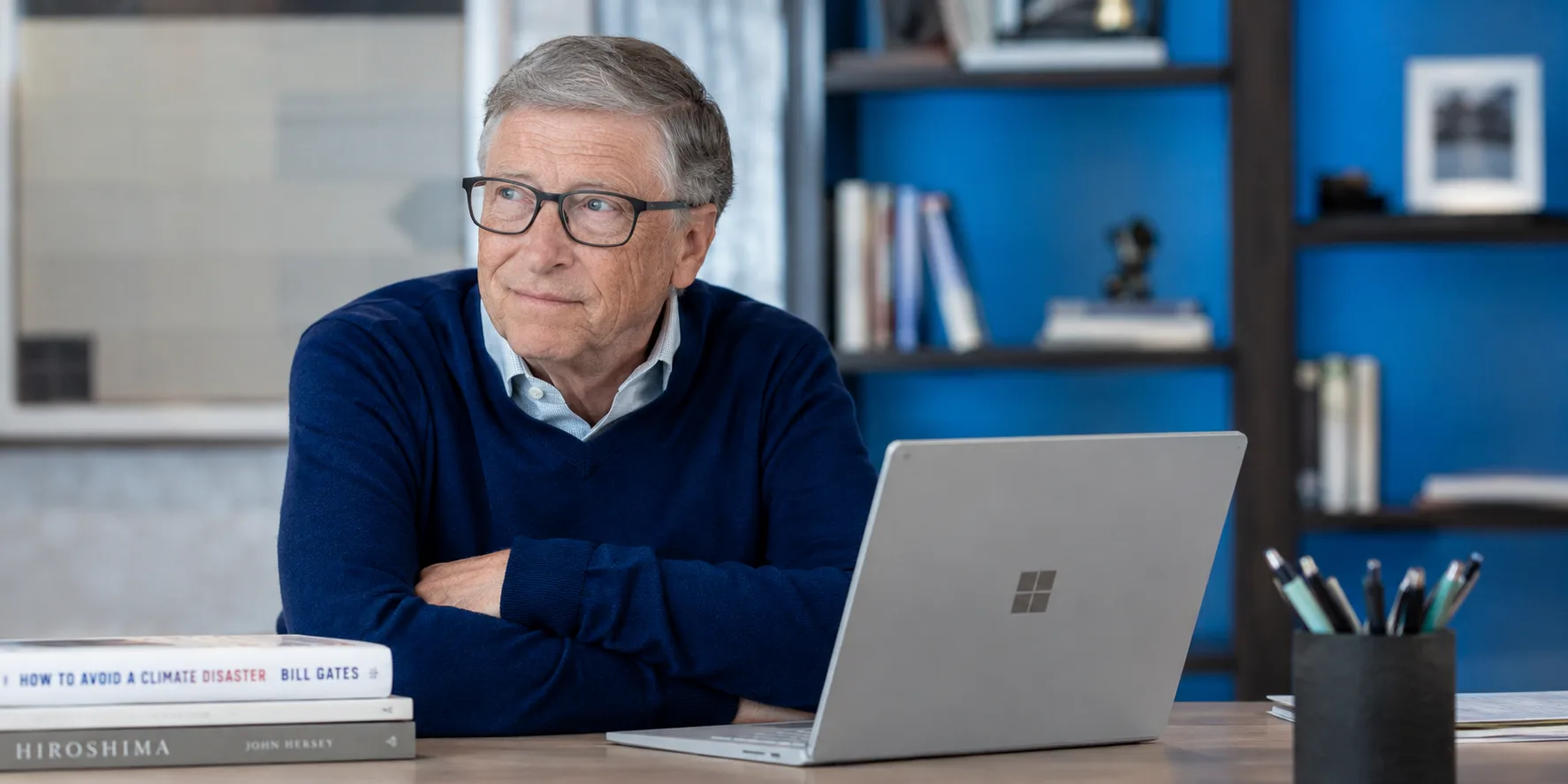
Most people know Bill Gates as the richest man on Earth. But here is the part that surprises almost everyone: he was writing computer code at age 13, sneaking out his bedroom window at night just to use a school computer. That obsession did not stop. It built Microsoft. It built a fortune. And now it is building a legacy worth $200 billion in global charity.
Bill Gates, born William Henry Gates III on October 28, 1955, in Seattle, Washington, is an American entrepreneur and philanthropist who co-founded Microsoft Corporation in 1975 with Paul Allen. He built the world’s largest personal-computer software company, became one of history’s youngest billionaires, and later pledged 99% of his fortune to global health and education through the Bill and Melinda Gates Foundation.
Quick Info: Bill Gates at a Glance
| Detail | Information |
| Full Name | William Henry Gates III |
| Date of Birth | October 28, 1955 |
| Birthplace | Seattle, Washington, USA |
| Parents | William H. Gates Sr. (lawyer), Mary Maxwell Gates (businesswoman) |
| Education | Lakeside School, Harvard University (dropped out) |
| Co-founder | Microsoft Corporation (founded 1975) |
| Microsoft CEO Tenure | 1975 to 2000 |
| First Billionaire Year | 1986 |
| Spouse | Melinda French Gates (married 1994, divorced 2021) |
| Children | Jennifer (b. 1996), Rory (b. 1999), Phoebe (b. 2002) |
| Net Worth (2026) | Approximately $107 billion |
| Foundation | Bill and Melinda Gates Foundation (founded 1994) |
| Memoir | Source Code: My Beginnings (February 2025) |
| Major Pledge | 99% of fortune, $200 billion to Gates Foundation by 2045 |
The Boy Who Fell in Love with Computers
The Bill Gates biography does not start in a garage or a dorm room. It starts in Seattle, in a household where books and ambition were everyday currency. His father, William H. Gates Sr., was a prominent attorney. His mother, Mary Maxwell Gates, served on major nonprofit boards, including the board of United Way of America.
Gates enrolled at Lakeside School, a private prep school in Seattle, at age 13. That is where everything changed. The school had a computer terminal connected to a General Electric mainframe, paid for by a Mothers’ Club rummage sale. Gates became obsessed immediately.
He wrote his first software program at 13, a game of tic-tac-toe. It sounds simple. But teaching a machine to play a game, step by step, logic by logic, gave him a feeling he never forgot. He later described it as a triumph, even though the machine was just doing exactly what he told it to do.
How Did a Teenager Build a Real Business?
Gates did not stay a hobbyist for long. At Lakeside, he teamed up with Paul Allen, a friend two years older than him. Together, they formed the Lakeside Programmers Group. They found bugs in a software company’s system and offered to fix them in exchange for free computer time. That deal taught Gates something important early: software had real commercial value.
By 16, Gates and Allen built a company called Traf-O-Data. It created a device that read raw data from traffic counters and produced reports for local governments. They sold it to Seattle city officials. The product had problems, but the experience was priceless. Two teenagers had just built and sold a real software product.
Gates also led a group that computerized their school’s payroll system. He later admitted he arranged access to computers that would be easier to exploit so he could spend more time programming. Even at 16, he was finding ways to stay ahead.
Harvard, Dropout, and the Bet That Changed Everything
In 1973, Gates enrolled at Harvard University. He was a math and pre-law student, but his real classroom was the computer lab. He stayed up for 36-hour stretches writing code. He barely slept. His roommate at the time later recalled that Gates had little interest in anything outside computing.
Then, in January 1975, something appeared on the cover of Popular Electronics magazine that changed both Gates and Allen’s lives forever.
What Was the Altair 8800, and Why Did It Matter?
The Altair 8800 was a kit computer made by a company called MITS. It was not much to look at. But it was the first commercially available microcomputer for everyday consumers. The moment Gates and Allen saw it, they recognized a problem: it had no software.
They called MITS immediately and said they had already written a BASIC programming language interpreter for the Altair. They had not written a single line yet. They had eight weeks to deliver.
They built it. It worked. MITS licensed the software, and Gates and Allen had their first real product. Gates left Harvard in 1975, during his sophomore year, to focus on the company they named Microsoft. He was 19 years old.
He later said he always planned to go back and finish his degree. He never did. But Harvard gave him an honorary doctorate in 2007, 32 years later.
How Microsoft Became a Global Empire
Microsoft’s early years were scrappy. The team was tiny. Gates wrote code himself. He reviewed every line his programmers wrote. He was known for pushing employees extremely hard and for asking aggressive questions in meetings if he thought someone had not done their homework.
The company moved from Albuquerque, New Mexico, where MITS was based, to Bellevue, Washington, in 1979, and later to Redmond.
The IBM Deal That Rewrote Computing History

In 1980, IBM approached Microsoft to supply an operating system for its new personal computer, the IBM PC. Gates did not have one. But instead of saying no, he bought a system called QDOS (Quick and Dirty Operating System) from a Seattle programmer named Tim Paterson for approximately $50,000. Microsoft licensed it to IBM as MS-DOS.
Here is the part that made Gates a genius: he did not sell the rights to IBM. He licensed the software. That meant every IBM-compatible PC maker, every clone manufacturer, had to come to Microsoft for the same operating system.
The IBM PC launched in 1981 and set the technical standard for the entire industry. MS-DOS launched with it. Suddenly, Microsoft’s software was on almost every personal computer on the planet. Gates had turned one smart deal into a monopoly.
You can read more about the history of personal computing and how software shaped the modern world on Wikipedia’s page on the History of Personal Computers.
Windows, Office, and the Road to Dominance
MS-DOS was text-based. You typed commands. In 1983, Apple released the Lisa and then the Macintosh, both with a graphical user interface (pictures and icons you clicked on). Gates saw that this was the future.
Microsoft released Windows 1.0 in 1985. It was slow and limited. But Gates kept improving it. Windows 3.0 in 1990 became a massive hit. Windows 95, in August 1995, drew lines around the block. People camped overnight outside stores just to buy an operating system. Nothing like that had ever happened before.
Microsoft Office bundled Word, Excel, and PowerPoint into one package. It became the standard for offices worldwide. Schools used it. Governments used it. Small businesses used it. The software ran on nearly every computer on Earth.
By the mid-1990s, Microsoft was the most valuable software company in the world, and Gates was one of the wealthiest private individuals in history.
Bill Gates and the Antitrust Battle
Power attracted enemies. As Microsoft grew, smaller competitors complained that Gates used predatory tactics to crush rivals. The most damaging accusation was about Internet Explorer.
When the internet exploded in the mid-1990s, a company called Netscape had the most popular browser. Gates responded by bundling Internet Explorer with Windows for free. Netscape could not compete with free. It rapidly lost market share.
In 1998, the U.S. Department of Justice filed an antitrust lawsuit against Microsoft. The case alleged Microsoft was using its Windows monopoly to illegally kill competition. In 2000, a federal judge ruled that Microsoft should be broken into two separate companies.
Microsoft appealed. The Bush administration settled the case in 2001 without breaking up the company. Microsoft agreed to share its application programming interfaces with other companies.
Gates faced intense scrutiny in congressional hearings. He sat before senators and took aggressive questions about business practices. The image of a nerdy software founder sitting before the U.S. Senate made front pages around the world.
How Did the Legal Battles Change Microsoft?
The antitrust case slowed Microsoft but did not stop it. Gates began shifting focus. He had already announced in January 2000 that Steve Ballmer would take over as CEO. Gates stayed on as chairman of the board.
The legal battle forced Microsoft to open parts of its system it previously kept closed. It also pushed Gates toward his next chapter: philanthropy.
The Shift to Saving Lives: Bill and Melinda Gates Foundation
In 1994, Bill Gates married Melinda French, a Microsoft product manager. The same year, they launched the William H. Gates Foundation, a small family charitable organization. By 1999, it grew and was renamed the Bill and Melinda Gates Foundation.
The foundation’s early work focused on libraries and education in the United States. Then the couple read a newspaper article about millions of children dying from diarrhea in developing countries, a disease easily preventable with cheap oral rehydration salts. Gates later said it stunned him. He could not believe that children were dying from something so preventable.
That article redirected the foundation’s entire mission. Global health became the primary focus.
What Has the Gates Foundation Actually Accomplished?

The numbers are staggering. By 2025, the Gates Foundation had already spent more than $100 billion on global health, education, and poverty reduction. Here is what that money has done:
- Helped reduce global polio cases by more than 99% since 1988, when Gates partnered with the Global Polio Eradication Initiative
- Funded vaccines through GAVI, the Vaccine Alliance, protecting hundreds of millions of children from measles, tetanus, and other diseases
- Distributed hundreds of millions of insecticide-treated bed nets to fight malaria in sub-Saharan Africa
- Funded tuberculosis and HIV treatment programs that reach some of the world’s poorest populations
- Supported agricultural research that raised crop yields and reduced hunger in rural Africa and South Asia
In 2006, Warren Buffett made the foundation even more powerful. He pledged the majority of his Berkshire Hathaway shares to the Gates Foundation. By 2025, approximately 41% of the foundation’s funds had come from Buffett.
In 2010, Gates and Buffett launched the Giving Pledge, a campaign encouraging the world’s billionaires to commit the majority of their wealth to charitable causes. Hundreds of the world’s wealthiest people have signed it.
You can read more about the Giving Pledge and its impact at the official Giving Pledge website.
Bill Gates in 2025 and 2026: The Biggest Pledge in History
The Bill Gates biography has a dramatic new chapter in 2025. In February 2025, Gates released Source Code: My Beginnings, the first volume of a three-part autobiography. The memoir covers his childhood, his time at Lakeside School, and his Harvard years. It ends just before Microsoft takes off, in 1979.
Gates told CBS News the book explores his childhood memory of viewing the world through a “prism of mathematics.” He described the early passion, the social awkwardness, and the obsession with computers that defined his teenage years.
Then in May 2025, Gates made the announcement that dominated headlines around the world.
What Is Gates Doing with His $107 Billion Fortune?
Gates pledged 99% of his remaining fortune, then valued at approximately $107 billion, to the Gates Foundation. The commitment will allow the foundation to spend $200 billion over the next 20 years.
He also announced that the foundation will close in 2045. Previously, the plan was for the foundation to continue 20 years after Gates’s death. This new timeline moves everything forward dramatically.
Gates said the foundation plans to concentrate on a focused set of high-impact goals: eradicating polio, reducing childhood malnutrition, and eliminating diseases like malaria. The planned annual budget is $9 billion per year.
“It’s kind of thrilling to have that much to be able to put into these causes,” Gates told the Associated Press in May 2025.
This pledge is expected to be the second-largest philanthropic gift in U.S. history when adjusted for inflation, behind only Warren Buffett’s total planned giving.
Bill Gates’ Personal Life: Family, Divorce, and What Comes Next
Gates married Melinda French on January 1, 1994, in Hawaii. They have three children: Jennifer Katharine Gates (born 1996), Rory John Gates (born 1999), and Phoebe Adele Gates (born 2002).
For decades, the couple was seen as one of the world’s most powerful philanthropic partnerships. Then in May 2021, they announced their divorce after 27 years of marriage. The announcement shocked the public. Neither provided a detailed public explanation at the time.
In June 2024, Melinda French Gates resigned from the Gates Foundation. The separation included $12.5 billion for her own philanthropic work. She has since started her own giving organization.
In 2025, Melinda published her memoir, The Next Day: Transitions, Change, and Moving Forward, which touched on her departure from the marriage and the foundation.
Gates’s personal life drew further attention in 2026 when he testified about his connection to Jeffrey Epstein. Gates publicly called his decision to meet Epstein a “grave error in judgment.” He acknowledged the relationship but stated clearly he had no knowledge of or involvement in Epstein’s criminal activities.
What Books Has Bill Gates Written?
Gates has published several influential books over the years:
- The Road Ahead (1995): His vision for the internet and digital future
- Business @ the Speed of Thought (1999): How technology can transform business decisions
- How to Avoid a Climate Disaster (2021): A detailed, solution-focused look at climate change
- How to Prevent the Next Pandemic (2022): A framework for global pandemic response
- Source Code: My Beginnings (February 2025): Part one of his autobiography
Bill Gates and Artificial Intelligence

Gates has been vocal about artificial intelligence since the release of advanced AI systems in 2022. He called the development of ChatGPT one of the most important technological advances he had seen since the graphical user interface.
He believes AI will be a major tool in the fight against global health crises. Gates has suggested that AI could help diagnose diseases in low-income countries where doctors are scarce. He also sees AI speeding up drug discovery and making personalized health guidance available to billions of people who lack access to regular medical care.
Gates still advises Microsoft on technology and said in January 2025 that he occasionally does product reviews for the company. He remains one of Microsoft’s most respected voices, even though he stepped down from the board completely in March 2020.
What Made Bill Gates Different from Other Tech Founders?
Thousands of people have built technology companies. Fewer than a handful have done what Gates did. What set him apart?
Relentless focus was one key factor. From age 13, Gates worked on software to the exclusion of almost everything else. He was not a well-rounded student in the traditional sense. He was extreme in one direction.
Strategic aggression was another. The IBM deal was not luck. Gates spotted the opportunity, bought QDOS cheaply, licensed it brilliantly, and never gave away the core asset. He understood leverage before most people in Silicon Valley had heard the word.
He was also a genuine technologist, not just a businessman. He could read code. He could write code. He could spot a bad architecture decision immediately. Employees said his technical questions in meetings were the hardest they faced.
And unlike many founders who coast once they reach the top, Gates reinvented himself completely. He went from the most aggressive businessman in tech to one of the most committed philanthropists on Earth. That transition took real conviction.
Key Takeaways
- Bill Gates co-founded Microsoft in 1975 at age 19, dropped out of Harvard, and built the world’s largest personal-computer software company from nothing.
- The 1981 IBM deal, in which Gates licensed MS-DOS rather than selling it, was the single business decision that gave Microsoft its global dominance.
- Gates became a paper billionaire in 1986 and was the world’s wealthiest private individual for much of the 1990s and 2000s.
- The Bill and Melinda Gates Foundation, launched in 1994, has already spent over $100 billion on global health, education, and poverty reduction.
- In May 2025, Gates pledged 99% of his estimated $107 billion fortune to the Gates Foundation, which will spend $200 billion and close by 2045.
- The Bill Gates biography is one of the few in history where the second act, the philanthropic mission, may prove even more consequential than the first.
A Legacy Still Being Written
The Bill Gates biography spans more than seven decades, but the most important chapters may still be ahead. He started coding at 13, built an empire by 30, and began giving it all away before he turned 60. Now, with a $200 billion plan to fight disease and poverty, he is in a race against the world’s most stubborn problems.
Gates has never been easy to define. He has been brilliant and ruthless. Visionary and obsessive. A businessman who bent rules and a philanthropist trying to fix the world. All of these things are true at once.
What is certain is that the Bill Gates biography is not the story of a man who got lucky with a computer. It is the story of someone who saw the future clearly, decades before anyone else, and refused to stop until he had shaped it.
Whether you are studying his rise, his business strategy, or his philanthropy, one lesson runs through every phase of his life: he always played for the highest possible stakes.
Frequently Asked Questions About Bill Gates
What is Bill Gates best known for?
Bill Gates is best known for co-founding Microsoft Corporation in 1975 with Paul Allen. Under his leadership, Microsoft created MS-DOS and the Windows operating system, making personal computing accessible to billions of people worldwide. He is also recognized as one of history’s most generous philanthropists through the Bill and Melinda Gates Foundation.
When and where was Bill Gates born?
Bill Gates was born on October 28, 1955, in Seattle, Washington, USA. His full name is William Henry Gates III. His father was a prominent attorney, and his mother served on major nonprofit boards, giving Gates a privileged but achievement-focused upbringing.
Why did Bill Gates drop out of Harvard?
Gates dropped out of Harvard University in 1975 during his sophomore year to co-found Microsoft with Paul Allen. The two had just secured a deal to write a BASIC interpreter for the Altair 8800 microcomputer. Gates saw a once-in-a-generation opportunity and chose to pursue it immediately rather than wait to finish his degree.
How did Bill Gates make his money?
Gates made his fortune primarily through Microsoft. The key moment was licensing MS-DOS to IBM in 1981 without giving up ownership rights. This meant every IBM-compatible PC manufacturer also needed Microsoft’s software. He became a paper billionaire in 1986 when Microsoft went public, and his wealth grew into the tens of billions throughout the 1990s.
How much money has Bill Gates donated to charity?
By 2025, the Bill and Melinda Gates Foundation had already spent more than $100 billion on global health, education, and poverty reduction. In May 2025, Gates pledged an additional 99% of his remaining $107 billion fortune, enabling the foundation to spend $200 billion more before closing in 2045. This makes his total expected giving one of the largest in human history.
Is Bill Gates still involved with Microsoft in 2025 and 2026?
Gates stepped down from Microsoft’s board of directors in March 2020. He no longer holds any formal leadership role at the company. However, he revealed in January 2025 that he still occasionally does product reviews for Microsoft as a technology adviser. His day-to-day focus is now entirely on the Gates Foundation and its global health mission.
What is Bill Gates working on right now in 2026?
As of 2026, Gates is focused on executing the Gates Foundation’s plan to spend $200 billion by 2045 on global health priorities, including polio eradication, malaria control, and childhood malnutrition. He is also working on the second volume of his three-part autobiography, following the February 2025 release of Source Code: My Beginnings. He remains active in advocating for AI as a tool for global health improvement.
Who is Bill Gates married to now?
Bill Gates and Melinda French Gates divorced in May 2021 after 27 years of marriage. As of 2026, Gates has not publicly announced a new marriage or long-term relationship. Melinda French Gates departed from the Gates Foundation in June 2024 and now runs her own philanthropic organization.
READ MORE: How to Improve Sleep Quality: The Complete Guide to Deeper, More Restorative Sleep
[…] READ MORE: Bill Gates Biography: From Code-Writing Kid to the World’s Greatest Philanthropist […]