

Most people think the Boston Brahmin types were just one rigid group of wealthy New Englanders. They were not. They split into distinct types, each shaping American history differently, and the story is far more interesting than you might expect.
“Boston Brahmin types” refer to the distinct categories within Boston’s historic upper-class elite, including old colonial families, merchant industrialists, Harvard-educated scholars, civic reformers, and philanthropists. Each type shared core values of education, restraint, and public duty but uniquely contributed to New England society. The term itself was coined by physician and writer Oliver Wendell Holmes Sr. in January 1860.
Quick Info: Boston Brahmin Types at a Glance
| Category | Key Detail |
| Term Coined By | Oliver Wendell Holmes Sr. |
| Year of Origin | January 1860, in The Atlantic Monthly |
| First Novel Use | Elsie Venner, 1861 |
| Origin of the Word “Brahmin” | The highest priestly caste in the Hindu caste system |
| Core Institutions | Harvard University (founded 1636), Boston Latin School, Boston Symphony Orchestra |
| Key Family Names | Adams, Cabot, Lowell, Winthrop, Forbes, Saltonstall, Parkman, Emerson |
| Political Trajectory | Federalists, then Whigs, then Republicans |
| Signature Style | Preppy dress code, Boston Brahmin accent, Beacon Hill residences |
| Legacy Institutions | Massachusetts General Hospital, Museum of Fine Arts, WGBH, Boston Athenaeum |
| Modern Status | Influence declined post-WWII; institutional legacy remains strong in 2025 |
What Are Boston Brahmin Types, Exactly?
The phrase “Boston Brahmin” seems to describe one kind of person. It does not. It describes a whole ecosystem of personalities, ambitions, and social roles that developed over roughly three centuries.
The Boston Brahmins, or New England Brahmins, are members of Boston’s historic upper class. From the late 19th century through the mid-20th century, they were often associated with a cultivated New England accent, Harvard University, Congregationalism and Unitarianism, and traditional British-American customs and clothing.
The phrase “Brahmin caste of New England” was first coined by Oliver Wendell Holmes Sr., a physician and writer, in a January 1860 article in The Atlantic Monthly. The term is derived from the Brahmin, the chief priestly caste in the Hindu caste system.
Think of it this way. If the Brahmin identity were a tree, the colonial founding families were the roots. The merchants and industrialists were the trunk. The scholars, reformers, and philanthropists were the branches. And today’s descendants are the leaves, still growing from the same base.
How Did the Term Come to Life?
Oliver Wendell Holmes Sr. coined the phrase in 1861 in his novel Elsie Venner. In it, he described Boston’s aristocracy as the “Brahmin Caste of New England.” Holmes wrote that they believed destiny had set them apart to create a shining city on a hill. And they embraced the values of their Puritan forebears: hard work, thrift, culture, and education.
Holmes was not flattering them blindly. He was identifying a real social pattern. Certain families in Boston reproduced not just wealth but a whole set of behaviors, intellectual habits, and expectations across generations.
The Boston Brahmins have long held the interest of casual and professional historians because of their unique place in nineteenth-century American culture. They were mostly the descendants of Puritans, having made their fortunes as American merchants, and they could not be described as egalitarian. Rather, they were the closest thing the United States has ever had to a true aristocracy.
The 7 Core Boston Brahmin Types, Explained
This is where most articles fall short. They describe the Brahmins as one group. But if you look closely at the historical record, you find at least seven distinct types. Each played a separate role.
Type 1: The Colonial Patricians (The Oldest Roots)
These are the families historians point to first. Their ancestors arrived in the 17th and early 18th centuries, many aboard ships like the Mayflower or the Arbella.
Many of the Brahmin families trace their ancestry back to the original 17th- and 18th-century colonial ruling class consisting of Massachusetts governors and magistrates, Harvard presidents, distinguished clergy, and fellows of the Royal Society of London, a leading scientific body.
Names like Winthrop, Adams, Saltonstall, and Dudley fall into this group. These were the founding architects of New England’s political and religious culture. They did not merely inherit prestige. They built the institutions that created it in the first place.
John Adams (1735-1826) is the clearest example. A second-generation Brahmin by culture, he became America’s second president. His son, John Quincy Adams, became the sixth. The Adams family alone spans nearly two centuries of direct American governance.
What Set the Colonial Patricians Apart
- Deep Puritan values: thrift, discipline, and communal responsibility
- Harvard connections date back to the college’s founding in 1636
- Political power as Massachusetts governors and judges
- Marriage strategies that kept wealth and status within a small circle of families
Type 2: The Merchant Industrialists (New Money, Old Manners)
Not every Boston Brahmin came from ancient colonial stock. A second type rose through trade, manufacturing, and industrial profit during the 18th and 19th centuries.
Many Boston Brahmin families made their fortunes as merchants and financiers before Holmes published his novel. If you hadn’t made your money by then, the only way into the caste was to marry into it.
Brahmin Oliver Ames, on the other hand, made his own fortune. He started manufacturing shovels in 1803 in Easton, Massachusetts.
The Forbes family is another perfect example. The Forbes family had made an early fortune in the China trade, built the transcontinental railroad, and gone on secret missions for Abraham Lincoln. The family made even more money investing in Alexander Graham Bell’s telephone.
These families earned their place through business success. Then they adopted the manners, the dress code, and the Harvard connections of the older families. Within a generation or two, they were indistinguishable from the old guard.
The Merchant Brahmin Playbook
- Build wealth through maritime trade, manufacturing, or finance
- Send sons to Harvard
- Marry daughters to old family names
- Fund philanthropic institutions to signal civic responsibility
- Adopt the understated dress code and calm social manner
Type 3: The Harvard Scholars and Intellectuals

In the Indian caste system, the Brahmin caste is the highest, most elite segment of society; in New England, the term referred to the old, wealthy families of Boston. The term encapsulated the status of a family’s roots but also their dignity, their societal connections, their philanthropy, and their appearance in society.
A third type centered not on land or commerce but on knowledge itself. These were the writers, professors, physicians, and thinkers who gave the Brahmin class its intellectual reputation.
Oliver Wendell Holmes Sr. himself was this type. A physician and poet who wrote for The Atlantic Monthly, he sat at the center of Boston’s literary world. His circle included Ralph Waldo Emerson, Henry Wadsworth Longfellow, and James Russell Lowell.
Boston Brahmins prized culture and education. Boston’s elite liked to think of their city as the “Athens of America.” For Boston Brahmins, Harvard College helped define this atmosphere.
The intellectual Brahmins did not just consume knowledge. They produced it. They wrote the essays, delivered the lectures, and shaped the public conversations that New England took seriously for generations.
H4: Why Harvard Was Central to This Type
Harvard was not just a school to the Brahmin intellectuals. It was a social and intellectual passport. Harvard College, founded in 1636, became a beacon of learning for generations of elite leaders. Attending Harvard signaled membership in the Brahmin world. Teaching was the highest intellectual honor.
Type 4: The Political Reformers
A fourth type used its social position for political change. These Brahmins moved through law, government, and public policy. Some were conservative by temperament. Others became reformers.
Politically, they were successively Federalists, Whigs, and Republicans. They were marked by their manners and once-distinctive elocution.
Take the example of Charles Sumner, a Massachusetts senator who became one of the most outspoken anti-slavery voices in Congress before the Civil War. He was badly beaten on the Senate floor in 1856 by a pro-slavery congressman from South Carolina. His empty chair in the Senate became a symbol of Brahmin resolve.
On the opposite side, Henry Cabot Lodge Sr. represents the more conservative wing of political Brahmins. Boston Brahmin Henry Cabot Lodge, a congressman from Massachusetts, introduced a bill in 1891 that would have required new immigrants to pass a literacy test before entering the country.
This tension within the political Brahmin type is real and important. They shared values around civic duty and educated leadership, but they disagreed sharply on what America should become.
Type 5: The Philanthropists

Perhaps the most visible type in 2025 is the philanthropist Brahmin. These families built the cultural and medical infrastructure that Boston still depends on today.
Brahmins founded the Boston Symphony Orchestra, the Peabody Essex and Isabella Stewart Gardner museums, WGBH, the Museum of Fine Arts, and the Boston Athenaeum. They followed their Puritan ancestors who started Boston Latin School, the first high school in the country. Brahmins founded elite college preparatory schools like Choate (now Choate Rosemary Hall), Groton, Andover, and Phillips Exeter.
This was not random generosity. It followed a specific Puritan logic. Wealth was a responsibility, not a reward. You gave back because you were expected to. Anything less was a moral failure.
A lot of Brahmin influence came quietly through giving. They founded museums, hospitals, and schools, often out of a sense of noblesse oblige. This pattern shaped Boston’s civic institutions and left a legacy you still see today.
Benjamin Bates IV (1808-1878) is a sharp example. A philanthropist who became the namesake and benefactor of Bates College, he gave his money to build an institution of higher learning that would outlast him by centuries.
Type 6: The Social Custodians (Lifestyle Brahmins)

Not every Brahmin built railroads or wrote philosophy. A sixth type preserved the cultural habits, manners, and social rituals that made the class recognizable.
These were the families who lived on Beacon Hill or in Back Bay, followed the dress code to the letter, and maintained the social calendar that kept the Brahmin world coherent.
There’s more to being a Boston Brahmin than simply having an early Puritan ancestor, graduating from Harvard, and living on Beacon Hill. You must not flaunt your wealth. You must shun glitzy resorts, and you must be thrifty, perhaps traveling by train. The one new suit you buy a year must adhere to the Boston Brahmin dress code, now known as “preppy.” You must speak in your own British-sounding dialect.
You must eat roast beef on Sunday night and cold leftovers on Monday. That’s where the expression “cold roast Boston” comes from.
This sounds trivial. It was not. These rituals were the social glue. They signaled group membership. They separated insiders from outsiders. And they maintained a consistent identity across generations when wealth alone could not do the job.
H4: The Brahmin Dress Code and What It Meant
The lifestyle Brahmins created the visual language of the American patrician style. Their distinctive Anglo-American manner of dress has been much imitated and is the foundation of the style now informally known as preppy. Brooks Brothers suits, penny loafers, and understated colors were not accidents of fashion. They were deliberate signals of belonging to this specific social world.
Type 7: The Brahmin by Marriage
A seventh and often overlooked type entered the Brahmin world through strategic marriage. This category deserves its own section because it reveals how the class actually reproduced itself over time.
Isabella Stewart Gardner became a Boston Brahmin, at least technically, when she married John Lowell Gardner Jr. However, she didn’t always adhere to the Brahmin code. Gardner posed for a painting in a low-cut dress, walked a lion down the street on a leash, and scrubbed the steps of an Anglo-Catholic Church during Lent.
Gardner is a fascinating figure. She entered the Brahmin world by marriage but then spent her life cheerfully breaking its rules. She founded the Isabella Stewart Gardner Museum in Boston in 1903, which is still one of the city’s most distinctive cultural institutions.
Former Secretary of State John Forbes Kerry is a classic example of a Brahmin by marriage. His father was descended from Austro-Hungarian Jewish immigrants who converted to Catholicism. His mother had the Forbes ancestors, and one of her sisters paid for his prep school education.
This type shows that the Brahmin identity was permeable. Money helped. Connections helped more. But the right marriage could open every door.
What Did All Boston Brahmin Types Have in Common?
Across all seven categories, certain traits appeared consistently. These were not accidents. They were the product of deliberate cultural transmission across generations.
Here is what united every variety of this elite class:
- Commitment to Harvard. Whether as students, professors, or donors, Harvard was the central institution binding all Brahmin types together.
- Public restraint over private display. Showing off wealth was considered vulgar. Quiet confidence was the standard.
- Civic duty is a moral obligation. Every Brahmin type, in some form, contributed to public life through politics, philanthropy, or institution-building.
- Anglo-Protestant cultural identity. Descendants of the earliest English colonists are typically considered to be the most representative of the Boston Brahmins. They are considered White Anglo-Saxon Protestants (WASPs).
- The accent. The Boston Brahmin accent, a distinctive non-rhotic variety of New England English, was a shared marker of belonging across all types.
The Brahmin Code: Social Rules That Shaped a Class
You cannot understand these distinct social types without understanding the code they all followed. It was unwritten, rarely discussed, and absolutely enforced.
Holmes felt the elites of New England were independent of the “feudal aristocracies of the Old World,” but many of the customs he pointed to as defining the Boston Brahmins resembled those of the British gentry, like requiring women to attend “finishing schools” and to marry into respectable white families, which often directly descended from those same British landowners.
The Brahmins borrowed heavily from the British gentry without admitting it. They called it American character. In practice, it looked a lot like Eton and Oxford transported to Cambridge and Beacon Hill.
The social code covered everything: how you dressed, who you married, where you vacationed, what you ate, and how loudly you spoke in public. The quieter you were about your status, the higher your actual status.
Geographic Identity: Beacon Hill, Back Bay, and Beyond
Location was never accidental for any of the Boston Brahmin types. Geography reinforced social identity in a physical, visible way.
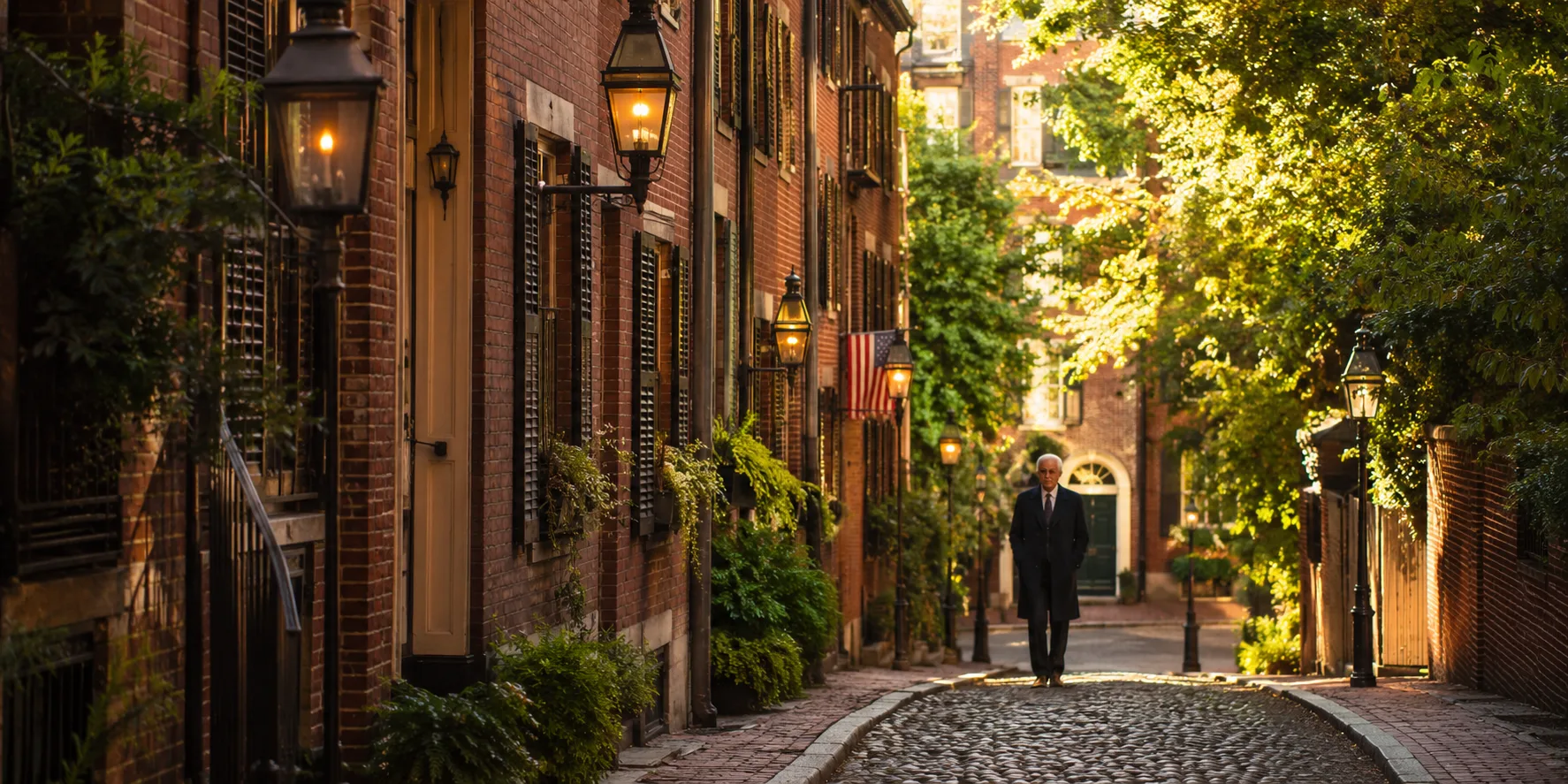
Beacon Hill and Back Bay became shorthand for old-money Boston. Those brick townhouses, gas lamps, and narrow lanes weren’t just pretty. They were on a stage. Living there signaled social rank and connected families to political and cultural networks.
The unique geography of Boston, a peninsula city, made expansion possible only by landfill. All of Boston’s new neighborhoods in the mid-19th century were created by leveling hills and using the dirt to fill areas of water to create new land. These new landfill areas were generally small and largely bordered by water, so it was easy to keep them exclusive. When immigrants did move into the newly fashionable Old South End, the Brahmins moved out.
This geographic exclusivity was not just snobbery. It was a survival strategy. By controlling where they lived, the Brahmins controlled who their children met, who they married, and who inherited access to their institutions.
How Boston Brahmin Types Changed Over Time
The Gilded Age Peak (1870s-1910s)
The Gilded Age marked a pinnacle for the Boston Brahmin types, characterized by opulence and influence. During this time, their wealth surged through industrial expansion and financial ventures. They transformed not just their fortunes but also the city’s landscape. Lavish mansions sprang up in Back Bay, serving as symbols of status and prestige.
This era also brought tension. New industrial wealth challenged old family prestige. The merchant Brahmin type grew dominant, sometimes overshadowing the older colonial families.
The 20th-Century Decline
The 20th century marked a turning point for the Boston Brahmin types. Their once-unquestioned dominance began to wane as social, political, and economic landscapes transformed dramatically. World War I and the Great Depression shifted priorities. New wealth emerged from industry and finance, challenging the established elite. The old guard found themselves facing competition from those who had risen through merit rather than lineage.
Cultural movements also played a role in this decline. The rise of progressive ideals diminished traditional hierarchies, while shifts in education opened doors for diverse voices previously excluded from high society.
The Modern Brahmin in 2025
Today’s Brahmins are often recognized in cultural and academic circles. Many descendants remain committed to education and philanthropy. Institutions like Harvard and MIT still carry echoes of their ancestral ties. However, the social landscape has changed dramatically. New wealth from tech entrepreneurs challenges the traditional power structures they established.
In 2025, you do not find a ruling Brahmin class in any clear political sense. What you find is institutional legacy. The schools they founded, the museums they built, and the hospitals they endowed still operate and still shape daily life in New England.
Why Did the New York Times Mini Crossword Bring This Topic Back?
Here is a detail most articles miss entirely.
Partly fueled by the NYT Mini Crossword, searches for Boston Brahmin types spiked in 2025. The clue led seekers to discover more about Boston’s early elite: who they were, where they came from, and how they influenced US society.
A single crossword clue sent thousands of curious readers down a historical rabbit hole. That tells you something important. This topic sits at the intersection of history, culture, and social class in a way that still resonates. People are not searching for trivia. They are searching for context about how America’s elite actually worked.
The Brahmins and Their Critics: A Fair Assessment
No honest account of these distinct social types avoids the criticism. The Brahmin class was not just a collection of scholars and philanthropists. It also held significant social power, which it used to exclude others.
Visiting Boston for the first time in the 1830s, Harriet Martineau noted that it was “perhaps as aristocratic, vain, and vulgar a city, as described by its own ‘first people,’ as any in the world.” What particularly distressed Martineau was the evidence of an aristocracy of wealth amid a new republic, a group whose cultural pretensions and social exclusivity she saw as particularly at odds with democracy.
As Andy Bowers at Slate explains, they had a hostility to the Irish and other immigrants.
These criticisms are accurate and important. The Brahmin class built extraordinary institutions. It also built walls. Understanding both sides is essential to understanding what these social types actually were and what they were not.
According to the New England Historical Society, the Brahmins also founded the New England Watch and Ward Society, a puritanical private citizens group active from 1878 to the 1920s, which actively banned books and plays, making Boston a target of national ridicule.
A full picture requires holding both realities at once: genuine civic contribution alongside genuine social exclusion.
Key Takeaways
- The term “Boston Brahmin” was coined in January 1860 by Oliver Wendell Holmes Sr. in The Atlantic Monthly, describing New England’s Anglo-Protestant upper class.
- At least seven distinct types existed within this elite class: colonial patricians, merchant industrialists, Harvard scholars, political reformers, philanthropists, lifestyle custodians, and Brahmins by marriage.
- Real institutions still exist today because of Brahmin philanthropy, including the Boston Symphony Orchestra, Massachusetts General Hospital, WGBH, and dozens of elite prep schools.
- The class was not sealed. Wealthy outsiders could enter through marriage, as John Forbes Kerry and Isabella Stewart Gardner both show.
- The Brahmin identity declined as a ruling force after World War II, but its institutional legacy continues to shape education, culture, and civic life in New England in 2025.
- The crossword effect is real. A 2025 NYT Mini Crossword clue about Boston Brahmin types sparked a wave of public curiosity, proving this topic still connects with modern readers.
Conclusion
The Boston Brahmin class was never a single type of person. It was a layered social ecosystem, with colonial founders at one end and modern philanthropic descendants at the other. In between sat merchants who built railroads; scholars who argued in The Atlantic Monthly; reformers who fought in the Senate; and lifestyle custodians who made sure everyone ate cold roast beef on Mondays.
Understanding the distinct Boston Brahmin types gives you a sharper lens for reading American history. You see how wealth, education, and civic duty can fuse into a lasting cultural identity. You also see how that identity can wall others out. Both things were true at the same time.
What endures is not the accent or the dress code. It is the institutions. The schools, the museums, the hospitals, and the universities that Brahmin families built over three centuries still shape daily life in New England. That is the real legacy of all seven types, and it is worth knowing.
Frequently Asked Questions
What does “Boston Brahmin types” actually mean?
The phrase refers to the distinct categories within Boston’s historic Anglo-Protestant upper class. Oliver Wendell Holmes Sr. coined the term “Brahmin Caste of New England” in January 1860, borrowing from the highest caste in the Hindu system. Different types emerged over time, from old colonial families to merchant industrialists to philanthropists, each contributing to New England’s cultural and civic identity in a different way.
Which families are considered the most classic Boston Brahmin families?
The most frequently cited family names include Adams, Cabot, Lowell, Winthrop, Forbes, Saltonstall, Parkman, Emerson, Endicott, and Lawrence. These families appear repeatedly in the records of Harvard governance, Massachusetts politics, and major philanthropic institutions throughout the 18th and 19th centuries.
Could someone become a Boston Brahmin without old family roots?
Yes. Two clear paths existed: commercial success followed by a Harvard education and strategic marriage, or direct marriage into an established family. Isabella Stewart Gardner entered the Brahmin world by marrying John Lowell Gardner Jr. in the 1860s, and John Forbes Kerry’s Brahmin identity came through his mother’s Forbes lineage.
What is the Boston Brahmin accent?
The Boston Brahmin accent is a distinctive, non-rhotic variety of New England English that was associated with this social class from the late 19th century through the mid-20th century. It was considered a mark of social refinement and class membership. The accent has largely disappeared among younger generations.
What institutions did Boston Brahmin philanthropists build?
The list is substantial. Key institutions include the Boston Symphony Orchestra, the Museum of Fine Arts, the Isabella Stewart Gardner Museum, WGBH public broadcasting, Massachusetts General Hospital, the Boston Athenaeum, Boston Latin School (the first public high school in America), and elite prep schools such as Groton, Andover, Choate, and Phillips Exeter.
Why did the Boston Brahmin influence decline in the 20th century?
Multiple factors worked together. The Great Depression and World War I disrupted old financial structures. Post-war economic growth created new wealth through tech, finance, and media that had no connection to old Brahmin families. Civil rights movements and immigration reform opened institutions to people that the Brahmin class had previously excluded. By the late 20th century, direct Brahmin social control over Boston’s institutions had faded significantly.
Are there Boston Brahmins still alive today?
Yes, descendants of Brahmin families still exist, and many remain active in education, finance, law, and philanthropy. However, they no longer form a socially unified ruling class. Their most visible presence in 2025 is through the institutions their ancestors built rather than through direct social or political dominance.
What was the relationship between Boston Brahmins and Harvard University?
Harvard was the central institution for all Boston Brahmin types. Founded in 1636, it trained Brahmin sons for law, medicine, politics, and business. Many Brahmin families served as Harvard governors or major donors. Attending Harvard was not just an education; it was a rite of passage and a social passport into the broader Brahmin network.
READ MORE: 5 Powerful Facts About 264.68.111.161: The Surprising Truth and What You Should Do
[…] READ MORE: 7 Powerful Boston Brahmin Types: The Best Guide to New England’s Most Influential Elite Classes […]